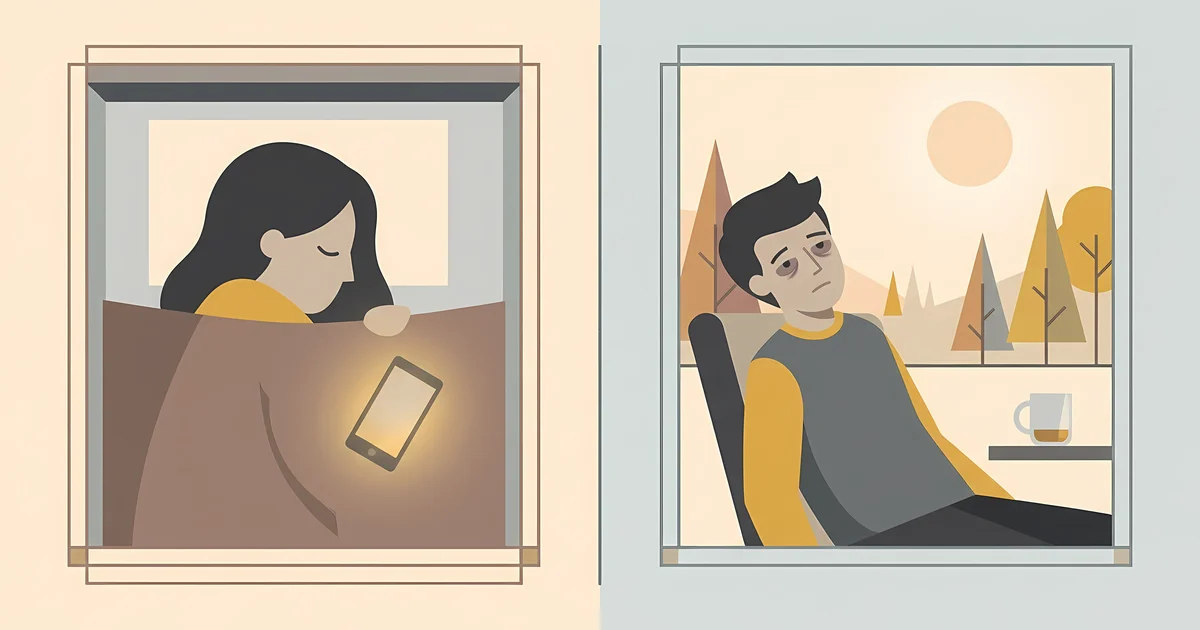
It’s late on a Sunday afternoon, and you haven’t done anything. No errands, no exercise, no chores. You’ve spent the last four hours wrapped in a blanket on the couch, phone in hand, moving nothing but your thumb.
And yet when you finally get up, your limbs feel heavy. Your head feels thick. Making dinner suddenly seems like a lot to ask of yourself.
If that sounds familiar, you’ve run into what might be called the stillness paradox: the body did almost nothing, but it feels like it did something enormous. The usual explanation — that you’re simply lazy, or out of shape, or bad at relaxing — doesn’t hold up very well against how consistently this happens to people who are otherwise disciplined and capable. Something else is going on, and it has less to do with your character than with how your brain spends energy.
The Brain You Forgot Was Working
The brain is a small but expensive organ. It makes up roughly 2% of body weight, yet it draws on something in the range of 20% of the body’s total metabolic energy at any given moment — a cost that doesn’t disappear just because you’ve stopped moving.
For a long time, neuroscientists assumed that a resting brain was something like an idling engine: mostly quiet, waiting for the next task. That assumption changed with the work of neurologist Marcus Raichle, whose research found that shifting from quiet rest into a demanding mental task barely moves the brain’s energy use at all — by less than about 5%. In other words, the brain’s background activity, generated largely by a set of interconnected regions known as the default mode network, already accounts for the large majority of its total energy budget. Deliberate, focused thinking is almost a rounding error by comparison.
This background network is what activates during daydreaming, mind-wandering, and — importantly — passive, unfocused scrolling. It isn’t dormant. It’s doing quiet, continuous work: processing social information, running internal narratives, evaluating what matters and what doesn’t. So when you “rest” by handing your attention to a stream of short videos or social posts, you’re not giving this system a break. You’re feeding it a denser, faster stream of material to process than it would get from simply staring at a wall.
There’s a more specific mechanism behind the fog that follows, too. A 2022 study published in Current Biology by researchers at the Paris Brain Institute found that after several hours of sustained, demanding mental effort, participants showed measurably higher glutamate concentrations in the lateral prefrontal cortex — the brain region most responsible for self-control and effortful thinking — along with a shift toward more impulsive, effort-avoidant choices. Glutamate is a normal and necessary neurotransmitter, but the researchers proposed that its buildup during sustained mental effort may make it physically harder for that brain region to keep functioning at full capacity, until rest allows the buildup to clear.
That study used structured, demanding cognitive tasks rather than social media scrolling, so it isn’t direct proof that an afternoon of scrolling produces the same buildup. But it does support a broader point worth taking seriously: sustained mental effort has a real, measurable metabolic cost, and clearing that cost seems to require something other than simply not moving your body.
The Real Cost of “Just Scrolling”
Metabolic fuel is only one part of the picture. The other is dopamine — and it’s widely misunderstood.
Dopamine isn’t primarily a “feel-good” chemical. In neuroscience, it functions more like a currency of motivation: it governs how much effort you’re willing to spend on anything, from replying to a text to getting up for a glass of water. There are two dopamine “settings” worth knowing about. One is tonic dopamine, your steady baseline of everyday drive. The other is phasic dopamine, the quick spike that fires when something novel or unexpected happens.
The Dopamine Rollercoaster
Short-form content is built almost entirely around triggering phasic spikes. A new clip, a punchline, a notification, a fragment of drama — each one is small, but they arrive in rapid succession, one after another, for as long as you keep scrolling.
According to opponent-process theory, a long-standing model of motivation, the brain works to keep itself in balance. Every artificial spike upward tends to be met with a corresponding dip below the previous baseline, as the system tries to protect itself from constant overstimulation. A single spike barely registers. But hours of repeated small spikes, each followed by a small compensatory dip, can gradually pull your baseline tonic dopamine down.
When that baseline drops, ordinary effort starts to feel disproportionately hard. Replying to an email, standing up, starting dinner — none of these require much energy under normal circumstances, but they can suddenly feel like they do. That’s not a discipline problem. It’s what a depleted motivational baseline actually feels like from the inside.
The Hidden Work of Watching
There’s a smaller, easy-to-miss cost as well: visual and attentional labor. Every time a video cuts, a caption appears, or a frame changes, your eyes make rapid involuntary movements called saccades, coordinated by a midbrain structure called the superior colliculus. At the same time, your prefrontal cortex is continuously sorting incoming visual fragments — deciding what’s relevant, what to look at next, what to ignore. It’s a low-grade, constant filtering job, running the entire time you’re “just watching.”
None of these processes are dramatic on their own. But stacked together over hours, they add up to something closer to sustained mental labor than genuine rest.
Two Sundays, Two Very Different Mondays
Picture someone who has worked hard all week and sets aside a Sunday afternoon to recover. They lie on the couch for six hours, moving between news sites, social feeds, short videos, and the occasional online store. Physically, they’ve barely used any energy. But cognitively, they’ve spent hours managing constant interruptions, tracking dozens of small narratives, and making a steady stream of micro-decisions about what to look at next. On Monday morning, they wake up foggy and unrefreshed, unable to explain why a day of “rest” left them feeling worse than before.
Now picture someone else who spends three hours walking a quiet trail or working in a garden. Their body does real work — hundreds of calories burned, legitimate physical tiredness by the end. But because the sensory environment is low-density and predictable, without rapid-fire novelty or dopamine volatility, their motivational baseline stays intact, and their prefrontal cortex gets the quieter conditions it needs to reset. They end the day physically tired, but mentally clear.
Same amount of time. Very different biological outcome.
Junk Rest vs. Real Rest
The pattern here points to a simple correction: physical stillness and neurological recovery are not the same thing.
Consuming high-stimulation media while lying down might be better described as junk rest — the neurological equivalent of junk food. It satisfies an immediate craving for stimulation or distraction, the same way sugar satisfies an immediate craving for calories, while leaving the underlying system — in this case, your neurochemistry — no better off, and often worse.
This mismatch makes more sense in evolutionary context. For most of human history, physical stillness and sensory stillness went together. Rest looked like sitting by a fire, watching a quiet landscape, being in an environment with very little to process. Nothing about that history prepared the nervous system to handle an unending, high-arousal information stream while the body stays motionless. The two used to be paired; now they’re routinely pulled apart.
Genuine recovery, in other words, isn’t really about doing less physically. It’s about taking in less, period.
How to Actually Recover
None of this means the couch is the enemy. It means what you do on the couch matters more than whether you’re on it. A few concrete shifts can make the difference between an afternoon that restores you and one that quietly drains you further.
Build zero-input windows
Scrolling while lying down is cognitive work dressed up as rest, not an actual recovery protocol. Try setting aside fifteen to twenty minutes with no screen at all — lying down, sitting in a quiet room, or just looking out a window. Giving your prefrontal cortex a genuine break from incoming information is what allows it to reset.
Try structured deep rest
Practices like Non-Sleep Deep Rest (NSDR) or slow, guided breathwork — often adapted from the older practice of yoga nidra — are worth trying in ten- to twenty-minute sessions. It’s worth being honest about the evidence here: some of the more striking claims about dopamine restoration from these practices trace back to small, early studies, not large clinical trials, so they’re promising rather than proven. Still, the broader evidence on yoga nidra-style practices for stress reduction and sleep quality is more established, and the basic idea — structured stillness without a screen — is consistent with everything above.
Move without a screen
If you’re foggy after a long stretch of sitting, more time on the couch with a phone usually makes it worse, not better. A twenty-minute walk without your phone can do more for you. The steady, forward visual motion of walking — what researchers call optic flow — appears to have a calming effect on the brain’s threat-detection systems, offering a kind of low-stimulation recovery that scrolling can’t replicate.
The Courage of Quiet
The next time you find yourself flat on the couch, glowing screen in hand, feeling inexplicably drained, it’s worth remembering: your body isn’t broken, and you’re not lazy. You’re running an evolutionary mismatch — a brain built for quiet stillness, spending its energy on a stream of stimulation it was never designed to absorb while motionless.
Real recovery doesn’t come from doing nothing while consuming everything. It comes from being willing to let things go quiet — long enough for whatever’s been running underneath to finally settle.
Sources
- Wiehler, A., Branzoli, F., Adanyeguh, I., Mochel, F., & Pessiglione, M. (2022). A neuro-metabolic account of why daylong cognitive work alters the control of economic decisions. Current Biology, 32(16). Sorbonne University / Paris Brain Institute (ICM/Inserm/CNRS/AP-HP).
- Raichle, M. E. “The Brain’s Dark Energy.” Scientific American, and related default mode network research from Washington University School of Medicine.
- Huberman Lab / yoga nidra research on Non-Sleep Deep Rest (NSDR), including discussion of preliminary small-sample findings on striatal dopamine.
- Opponent-process theory of motivation (general behavioral neuroscience literature).
==================================================
H. FAQ
==================================================
Is it bad to rest on the couch?
No — the couch itself isn’t the problem. What you take in while you’re on it is. Reading quietly, listening to calm music, or simply resting without a screen can be genuinely restorative.
Why does a walk feel more relaxing than watching videos?
A walk delivers steady, predictable, low-arousal sensory input, which doesn’t trigger the same rapid dopamine spikes and dips that fast-cut, novelty-driven content does — even though it costs more physical energy.
Is “junk rest” a real scientific term?
No — it’s a descriptive term used in this article to capture a pattern that current research supports: high-stimulation passive consumption behaving like a short-term fix that doesn’t produce real neurological recovery.
How long does zero-input rest need to be to help?
There’s no single proven number, but starting with 15–20 minutes of screen-free stillness is a reasonable, low-effort place to begin.