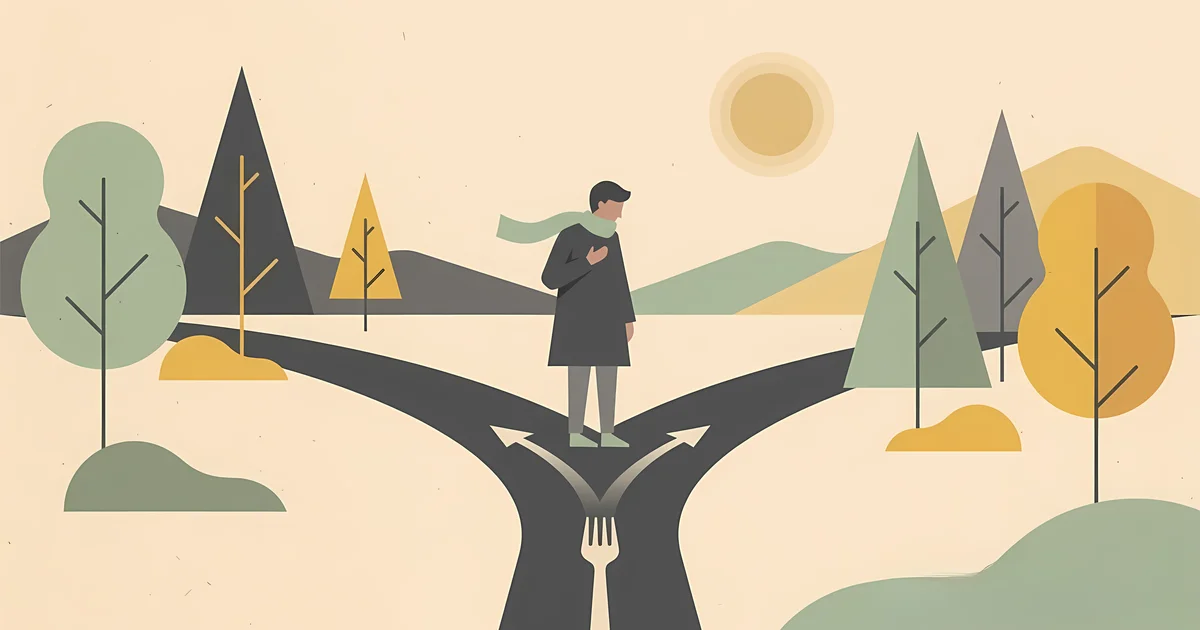
You’re at your desk, looking at a blank screen or a stack of work that feels enormous. You tell yourself that if you just found the right playlist, watched one quick video, or waited a little longer for the right mood to arrive, you’d be able to begin. So you wait.
It’s worth asking a different question:
What if that wait isn’t preparation at all?
What if the search for the right feeling before starting is the very thing keeping you from starting?
The Wait for the Spark
Most of us were raised on a simple, unspoken assumption: action follows motivation. If you don’t feel like doing something, you’re not ready yet. Motivation gets treated like a fuel you have to locate before the engine can turn over.
But that story doesn’t hold up particularly well against how most meaningful work actually gets done. A farmer doesn’t wait to feel inspired before the harvest — the crop won’t wait either.
Most long projects, in most fields, move forward on schedules and commitments, not on waves of enthusiasm. Motivation, when it does show up, tends to behave more like a flare than an engine: bright, brief, and not built to run anything for very long.
Why Your Brain Resists Starting?
There’s a biological reason the resistance to starting feels so specific and so physical. The brain is expensive to run — it accounts for roughly 20% of the body’s energy use despite being about 2% of its mass.
Faced with a new, complex, or uncertain task, the brain has a built-in bias toward caution: staying in a low-effort, predictable state is metabolically cheaper than committing to something demanding and open-ended.
That heavy, reluctant feeling before starting a task isn’t a verdict on your interest or your abilities. It’s closer to a default setting — a conservative bias built to avoid unnecessary effort, not an accurate read on whether the task is worth doing.
You’re a Bad Judge of Your Future Self
There’s a second factor working against you, and it has more to do with prediction than energy. Psychologists call it affective forecasting — our tendency to misjudge how we’ll feel in a future situation, especially one we haven’t started yet.
Sitting on the couch, tired and resistant, it’s easy to assume that feeling will hold steady for the next two hours of work. Research on affective forecasting consistently shows this kind of prediction is unreliable — people are simply not very accurate at guessing how they’ll feel once they’re actually in the middle of something, as opposed to imagining it from the outside.
In practice, this means the resistance you feel before starting a task is a poor predictor of how the task will actually feel once you’re in it.
Dopamine Has the Order Backwards
A common misunderstanding compounds the problem. Dopamine is often talked about as a reward chemical — a payoff you get after finishing something. But research distinguishing dopamine’s role in “wanting” versus “liking” points to something different: dopamine functions more as a signal of anticipation and pursuit than pure pleasure, and it tends to build once you’re engaged in an activity, not necessarily before you begin it.
If that’s roughly right, then waiting to feel a dopamine-driven pull toward a task before starting is asking for the reward ahead of the effort. The sequence is backwards. Starting first — even in a small, unremarkable way — is often what invites the motivational lift, rather than the other way around.
The First Step Is the Hardest — Not the Whole Task
There’s a classic psychological finding that supports this: unfinished tasks tend to occupy the mind more persistently than finished ones — a pattern known as the Zeigarnik effect. Once something is underway, there’s a pull toward completing it that simply doesn’t exist while it’s still hypothetical.
In practice, this suggests that most of the resistance to a task is front-loaded onto the moment before starting. Once the first small step is taken, the friction tends to ease — not because willpower increased, but because the task shifted from “something I’m dreading” to “something I’m already doing.”
How Athletes and Writers Actually Show Up
Elite athletes don’t train because they wake up every day feeling inspired. They train because training is built into a routine that doesn’t ask permission from their mood — pre-set rituals, habits, and schedules that operate independently of how they feel on a given morning.
The same pattern shows up in creative work. Picture two writers. One waits for the muse — for the right mood, the right morning, the right amount of inspiration — and ends up with long stretches of nothing. The other treats the work like a trade: sit down, write two hundred words, stand up, regardless of how the words come out that day. A year later, one of them has a manuscript.
It’s worth noting a real nuance here, since “passion for your work” often gets unfairly blamed for burnout. Research distinguishing harmonious passion (an activity you engage with by choice, integrated with the rest of your life) from obsessive passion (one you feel compelled to do, often at the expense of everything else) suggests it’s not passion itself that predicts burnout — it’s the obsessive, can’t-let-go version of it. Process, in other words, isn’t the enemy of passion. It’s often what makes passion sustainable.
Three Ways to Start Without Waiting to Feel Ready
1. The Two-Minute Rule
Don’t commit to finishing the project — commit to two minutes of it. The barrier to starting something for 120 seconds is so low that the usual resistance to a large, undefined task rarely has room to kick in. Often, once the two minutes are up, continuing feels easier than stopping. And if you do stop there, that still counts — the goal was breaking the stillness, not finishing the whole thing in one sitting.
2. Move first, think second
Standing up, walking to your desk, opening the document, picking up the pen — these are physical, almost mindless actions, but they tend to nudge the brain toward planning mode rather than the other way around. Instead of waiting for your mind to decide it’s ready, let your body go first.
3. Aim for the smallest possible output
Perfectionism often disguises itself as high standards, but it functions a lot like procrastination — it keeps the bar so high that starting feels risky. Lower it deliberately. One sentence. One email. One set of reps. Small, easily achievable goals keep you moving without triggering the kind of anxiety that makes starting feel dangerous.
The Engine You Already Have
Motivation was never really the fuel — it was the flare. It looks dramatic, but it burns out fast, and it was never built to carry the whole task on its own.
What actually gets things done is closer to an engine: steady, unglamorous, running whether or not you feel like it that day. You don’t need to feel differently before you begin. You need to make the first move small enough that beginning doesn’t require a feeling at all.
Stop asking whether you feel like it. Ask what the smallest possible move is — and make it.
Sources
- Gilbert, D. T., & Wilson, T. D. (2007). Prospection: Experiencing the Future. Science, 317(5843), 1351–1354. Foundational work on how people imagine and predict the emotional consequences of future events. DOI · PubMed
- Wilson, T. D., & Gilbert, D. T. (2003). Affective Forecasting. Advances in Experimental Social Psychology, 35, 345–411. Foundational review of affective forecasting and common sources of error in predicting future feelings. DOI
- Zeigarnik, B. (1927). Das Behalten erledigter und unerledigter Handlungen [The Memory of Completed and Uncompleted Actions]. Psychologische Forschung, 9, 1–85. Original work associated with the Zeigarnik effect. Later research has found that the effect is more context-dependent than the original account suggested. DOI · Google Books
- Berridge, K. C., & Robinson, T. E. (1998). What is the role of dopamine in reward: Hedonic impact, reward learning, or incentive salience? Brain Research Reviews, 28(3), 309–369. Foundational work distinguishing dopamine-related incentive salience (“wanting”) from hedonic pleasure (“liking”). PubMed · DOI
- Berridge, K. C., & Robinson, T. E. (2016). Liking, wanting, and the incentive-sensitization theory of addiction. American Psychologist, 71(8), 670–679. PubMed · DOI
- Vallerand, R. J., Paquet, Y., Philippe, F. L., & Charest, J. (2010). On the Role of Passion for Work in Burnout: A Process Model. Journal of Personality, 78(1), 289–312. Wiley Online Library · DOI · PubMed
H. FAQ
Is it true that motivation comes after action, not before?
Often, yes — research on dopamine’s role in anticipation and pursuit suggests motivation tends to build once you’re engaged in a task, rather than needing to arrive first. That said, this isn’t an absolute rule; some tasks do generate real enthusiasm before you begin. The pattern described here is a common one, not a universal law.
What is the Two-Minute Rule?
A practical technique where you commit to just two minutes of a task, rather than the whole thing, to lower the barrier to starting. It’s a behavioral tool, not a guaranteed neurological trigger.
Is wanting to feel passionate about your work unhealthy?
No — research actually distinguishes “harmonious” passion (chosen, integrated into a balanced life) from “obsessive” passion (compulsive, all-consuming). It’s the obsessive version that’s linked to burnout, not passion itself.
Does this mean feelings don’t matter at all?
No. The point isn’t to ignore emotion — it’s that waiting for a specific feeling before acting is often an unreliable strategy, since people are notoriously bad at predicting how a task will actually feel once they’re in it.