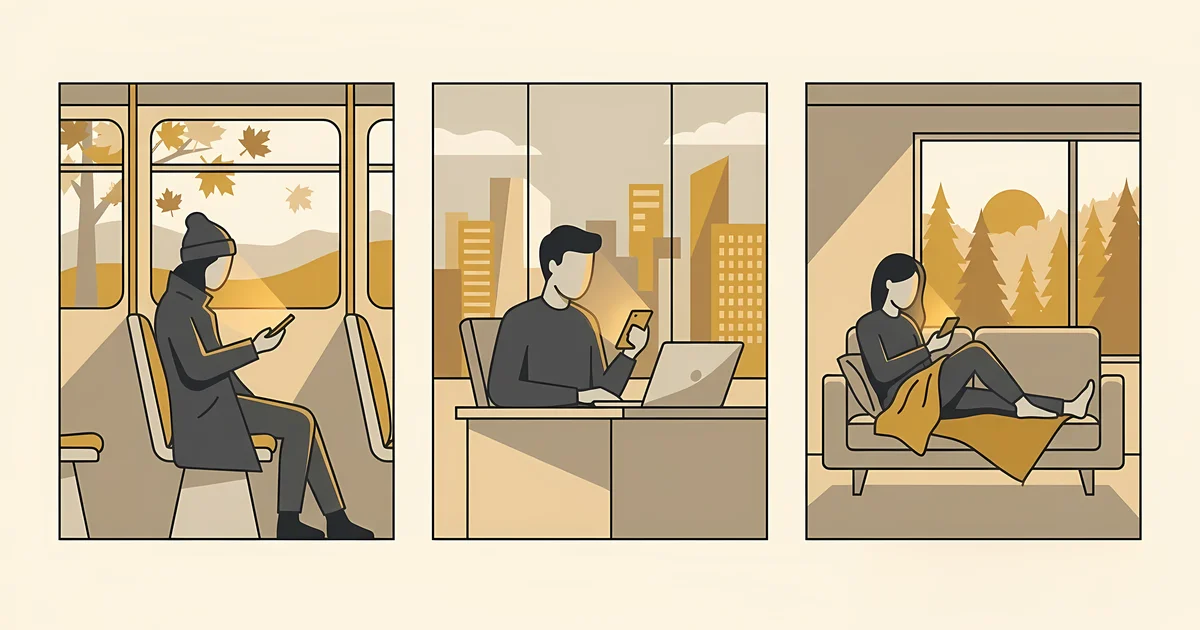
In 2014, researchers at the University of Virginia and Harvard ran a simple experiment: sit alone in a quiet room for fifteen minutes. No phone, no book, nothing to do but think.
Before the session, nearly everyone said they’d pay money to avoid a mild electric shock. Left alone with their thoughts, though, a striking number chose it anyway — about two-thirds of men and a quarter of women pressed a button to shock themselves rather than sit through fifteen minutes of unfiltered quiet.
It raises a real question: why does ordinary silence feel difficult enough that physical discomfort starts to look like the easier option?
A World That Fills Every Gap
Most people today rarely encounter genuine, unstructured quiet. A line at the store, a red light, a few minutes before a meeting — nearly every small gap gets filled automatically, usually with a phone. On paper, this looks like constant connection. Underneath it, something quieter tends to accumulate: a low hum of mental fatigue that doesn’t obviously trace back to any one cause.
The moment the noise actually stops — screens off, nothing scheduled — an uncomfortable stillness tends to show up fast. For many people, the instinct is to treat that stillness as something to fill rather than something to sit with.
Why Silence Feels Confrontational
Part of the explanation is straightforwardly cognitive. Managing a conversation, reading a room, tracking how you’re coming across — all of this draws on limited attentional resources, and in the presence of other people, that system rarely fully relaxes. Constant social engagement is its own kind of ongoing work, even when it doesn’t feel effortful in the moment.
But there’s a deeper layer too. When external noise disappears, there’s nothing left to compete with whatever’s already present internally — unresolved tension, low-grade anxiety, thoughts that normally stay in the background. Choosing an electric shock over fifteen quiet minutes wasn’t really about boredom. It looks more like an attempt to avoid sitting with an unfiltered version of one’s own mind.
Solitude Is Not Loneliness
Here’s a distinction worth being precise about: solitude and loneliness are not the same experience wearing different names.
Loneliness is a subjective sense of deficit — feeling excluded, unchosen, cut off against your will. It’s genuinely distressing, and it’s associated with elevated stress and real harm to wellbeing. Solitude, by contrast, is voluntary: a deliberate choice to step out of social input for a while. The difference isn’t cosmetic — it appears to be the key variable that determines whether time alone helps or hurts.
What Chosen Quiet Actually Does
In a well-documented 2017 study, researcher Thuy-vy Nguyen and colleagues Richard Ryan and Edward Deci found that voluntarily chosen solitude produces what they called a “deactivation effect”: time alone measurably reduces the intensity of high-arousal emotional states.
It’s worth being precise here — the effect applies to both strong positive and strong negative emotion, not negative feelings exclusively. Solitude doesn’t simply suppress anger or anxiety; it tends to turn down the volume on intense emotional arousal generally, leaving something closer to a calmer, more neutral baseline.
This fits with what’s known about the brain during low-input states more broadly. When external demands drop, a network of brain regions known as the Default Mode Network tends to become more active — not idling, but turning attention inward, supporting memory consolidation and the kind of unhurried processing that rarely happens while actively engaged with the outside world.
An Old Practice, Not a New Trend
None of this is a modern discovery. Marcus Aurelius wrote, in a well-known passage from Meditations, about retreating into his own mind as one of the few genuinely peaceful places available to him — notable, given that he wrote it while ruling an empire through war and political crisis.
He seemed to understand something that modern research is now describing with more precision: a mind that can’t tolerate its own company stays at the mercy of whatever’s happening externally.
Henry David Thoreau’s two years at Walden Pond followed a similar instinct. So does the modern practice of structured “Think Weeks” — periods some business leaders deliberately spend away from devices, staff, and scheduled input, specifically to clear mental clutter and think through difficult decisions.
Mental Toughness Redefined
There’s a cultural habit of treating being alone — eating alone, traveling alone — as a quiet sign of social failure. The research points the other direction: comfort with one’s own company looks less like a deficiency and more like a specific, buildable capacity.
Being alone with an unfiltered mind, by definition, removes the usual performance that happens around other people — adjusting tone, managing how you’re perceived, softening opinions to fit the room.
What’s left is closer to an unedited version of your own thinking. That can be uncomfortable at first. It isn’t a flaw in your resilience. It’s closer to a different kind of fitness, one that gets built the same way most things do: with practice.
Three Ways to Build the Capacity
1. The daily zero-input window
Set aside fifteen minutes, no phone, no book, no specific task — not even meditation with a goal attached. Just sit. The point isn’t productivity; it’s practicing tolerance for unstructured quiet itself.
2. Reframe the internal story
When the discomfort of being alone shows up, the instinct is often to interpret it as “I’m isolated” or “there’s nothing to do.” Try shifting the framing to something closer to “I’m choosing to check in with myself.” That shift — from passive deficit to active choice — tracks with research on autonomy as a core driver of psychological wellbeing.
3. Tolerate the first wave of discomfort
The initial minutes of real quiet often bring a spike of restlessness or low-grade anxiety. That’s not a sign something’s wrong — it’s closer to whatever’s been running quietly in the background finally having room to surface. Resisting the urge to immediately reach for a distraction, and letting that first wave pass, is most of what builds the underlying tolerance.
A Place Worth Living In
The people who shocked themselves in that 2014 study weren’t broken. They simply hadn’t built much tolerance for their own unfiltered company — and most people haven’t, because modern life rarely requires it.
Mental toughness, in this light, isn’t only about how well you handle external chaos. It includes something quieter: how peacefully you can sit in an empty room with no notifications, no audience, and no immediate task. The next time stillness shows up, it might be worth resisting the urge to fill it. Your own mind is somewhere you spend a great deal of time — worth getting more comfortable in.
Sources
- Wilson, T. D., et al. (2014). “Just Think: The Challenges of the Disengaged Mind.” Science, 345(6192), 75–77. Science
- Nguyen, T. T., Ryan, R. M., & Deci, E. L. (2018). “Solitude as an Approach to Affective Self-Regulation.” Personality and Social Psychology Bulletin, 44(1), 92–106. PubMed
- Ryan, R. M., & Deci, E. L. (2000). “Self-Determination Theory and the Facilitation of Intrinsic Motivation, Social Development, and Well-Being.” American Psychologist, 55(1), 68–78. PubMed
- Winnicott, D. W. (1958). “The Capacity to Be Alone.” International Journal of Psychoanalysis, 39, 416–420. Psychoanalytic Electronic Publishing
- Marcus Aurelius. Meditations, Book IV — reflections on withdrawing into one’s own mind. MIT Classics
- Thoreau, H. D. (1854). Walden; or, Life in the Woods. Project Gutenberg
FAQ
Is solitude the same as loneliness?
No — they’re structurally different. Loneliness is a distressing sense of unwanted isolation; solitude is a voluntary choice to spend time alone. Research suggests only chosen solitude is reliably associated with calming, restorative effects.
Does solitude only reduce negative emotions like anxiety?
Not exactly — the research shows it reduces the intensity of both strong negative and strong positive emotions, producing a calmer overall state rather than selectively dialing down bad feelings.
Is it unhealthy to prefer being alone?
Not inherently — comfort with solitude is generally seen as a sign of psychological maturity, not social failure. It becomes a concern only if it’s used to consistently avoid relationships or accountability a person actually wants or needs.
What if solitude makes me feel worse, not better?
If quiet consistently brings up distressing, hard-to-manage thoughts rather than calm, it may be worth exploring with a mental health professional, especially if there’s a history of trauma or unprocessed difficult experiences — unguided silence isn’t automatically therapeutic for everyone.