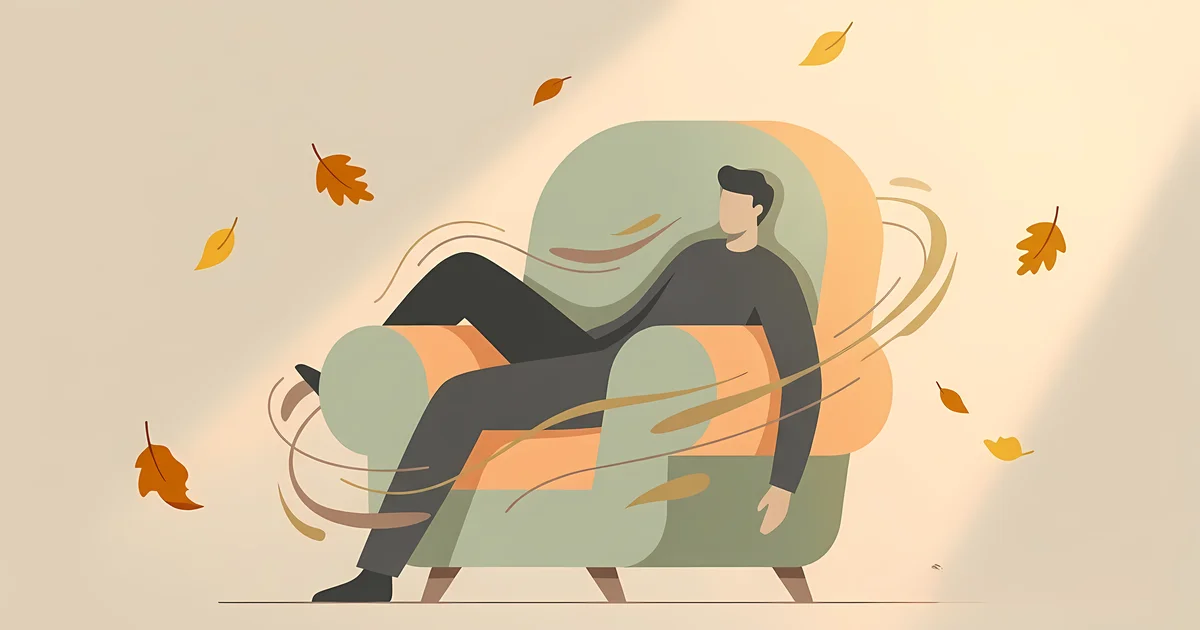
On a low, rainy evening, there’s a strange impulse that sometimes takes over. Instead of reaching for something uplifting, you do the opposite: put on the saddest playlist you own, dim the lights, and sit with it. You tell yourself you’re processing something. Hours later, you’re still there.
It’s a common enough pattern that it’s worth asking honestly: why would a mind that wants to feel better keep steering itself back toward the thing that hurts?
Sadness Isn’t Just an Absence of Good Feeling
For a long time, lingering sadness got explained as a simple malfunction — a dip in serotonin, nothing more. The fuller picture is more interesting. When researchers study what happens in the brain during sad music or painful memory recall, sadness doesn’t just look like reduced activity. In some of this research, it engages the nucleus accumbens and ventral striatum — the same reward-related regions involved in pleasurable experiences.
There’s also a long-standing, well-known claim about crying specifically: that emotional tears differ chemically from the tears triggered by, say, cutting an onion, containing higher levels of prolactin, ACTH, and leucine-enkephalin (a natural painkiller).
It’s worth being honest about the state of this evidence — the original findings, from researcher William Frey, are widely cited, but crying researchers today note that this specific claim has never been independently replicated in the decades since, despite attempts. It hasn’t been disproven, but it also hasn’t been confirmed the way a well-established finding usually is. So it’s fair to treat it as a genuinely interesting, still-open hypothesis rather than settled fact.
What’s more solidly established is something less dramatic but arguably more important: sadness engages real biological processes. It isn’t simply an empty, passive state.
Why the Brain Prefers Predictable Over Pleasant
Here’s the deeper, more counterintuitive piece. To the subconscious mind, safety isn’t defined by pleasure — it’s defined by predictability. The nervous system works to maintain a familiar baseline, a process sometimes called emotional homeostasis. And familiar sadness, however uncomfortable, is predictable in a way that happiness usually isn’t.
Happiness carries real risk: the possibility of disappointment, of raised expectations, of something good ending. Sadness offers none of that uncertainty. Once it becomes a familiar emotional home base, the subconscious can start reading that familiarity as a kind of protection — not because sadness feels good, but because it feels known.
How the Loop Gets Built
This gets reinforced the same way most habits do. In neuroscience, this pattern is often summarized as “neurons that fire together, wire together” — a foundational principle known as Hebbian learning. Every time attention returns to rumination or a low mood, that neural pathway gets a little more worn in.
Picture the brain as a dense forest. Walking the same low, muddy path toward sadness again and again turns it into a wide, easy trail. Meanwhile, the path toward something new — optimism, risk, unfamiliar joy — stays overgrown, because it hasn’t been walked nearly as often. It’s not that the new path is impossible. It’s just genuinely more effortful, at least at first, than the well-worn one.
The Secondary Comforts of Staying Sad
There’s also a less obvious payoff. Sadness quietly lowers what’s expected of you. It gives permission to slow down, to withdraw, to not perform. For some people, it also carries a sense of depth or seriousness that can feel, in a strange way, like part of their identity. Over time, that identification can grow strong enough that genuine joy starts to feel like a threat to who someone believes themselves to be — not consciously chosen, but genuinely hard to step away from.
None of this means the sadness is fake or performative. It means the loop has real reinforcement built into it, on top of whatever the original sadness was actually about.
What Sadness Was Actually For
It helps to remember that sadness isn’t a design flaw. In evolutionary terms, it likely functioned as a kind of conservation-withdrawal strategy — a signal that pushed an injured or grieving individual to slow down, stay quiet, and conserve energy rather than push forward into more risk. As a temporary state, that’s protective. The trouble starts when a temporary shelter gets mistaken for permanent housing.
This is also why forcing relentless positivity over genuine grief tends to backfire — pushing away legitimate sadness doesn’t resolve it, and suppressing emotion generally keeps the body’s stress response running in the background rather than actually easing it. The goal isn’t to eliminate sadness or override it with forced cheer. It’s to recognize when the “shelter” has become the default address.
Three Gentle Ways to Build a New Path
Interrupt the pattern physically
Rumination tends to thrive when the body is still and the mind is left to wander unsupervised. The moment you notice the pull toward a familiar low-mood spiral, change something physical: leave the room, splash cold water on your face, take a short walk. A shift in physical environment tends to break the automatic momentum of the loop, at least enough to create a pause.
Reappraise instead of just venting
Talking through a difficult feeling is genuinely useful — but retelling the same story on repeat, without adding any new perspective, tends to deepen the groove rather than resolve it. Try asking a more specific question: what’s one concrete fact about this situation? Is there anything useful I can take from it? That small shift in framing tends to engage more deliberate, forward-looking thinking rather than simply replaying the same emotional loop.
Hold the good moments a little longer
When something small and genuinely pleasant happens — a quiet moment, a good cup of coffee, an easy conversation — resist the urge to move past it immediately. Pause for a few seconds and actually notice it. Repeated, deliberate attention to small positive moments is a reasonable way to start building an alternate pathway, even if it takes real time before it feels as familiar as the old one.
Out of the Shelter, Into the Open
Sadness is a genuine, necessary part of being human. It signals that something needs attention, care, or reflection — it was never meant to be erased entirely. The next time the pull toward a familiar low mood shows up, it’s worth pausing to notice what’s actually happening: not a failure of willpower, but a nervous system reaching for something predictable because predictable has, for a long time, felt like the safest option available.
That doesn’t mean staying there. Predictability might feel safe. But life — and most of what’s worth having in it — happens out in the open.
Sources
- Frey, W. H., II, DeSoto, D. M., Hoffman, C., & McCall, J. T. (1981). Effect of Stimulus on the Chemical Composition of Human Tears. American Journal of Ophthalmology, 92(4), 559–567. The study reported differences in some components of emotional and irritant-induced tears; subsequent discussion has noted that the broader claim that crying chemically “removes toxins” has not been independently established. PubMed · DOI
- Salimpoor, V. N., Benovoy, M., Larcher, K., Dagher, A., & Zatorre, R. J. (2011). Anatomically distinct dopamine release during anticipation and experience of peak emotion to music. Nature Neuroscience, 14, 257–262. Research linking emotionally evocative music with dopamine activity in the caudate and nucleus accumbens. PubMed · DOI
- Salimpoor, V. N., van den Bosch, I., Kovacevic, N., McIntosh, A. R., Dagher, A., & Zatorre, R. J. (2013). Interactions between the nucleus accumbens and auditory cortices predict music reward value. Science, 340(6129), 216–219. Research examining interactions between auditory regions and the nucleus accumbens during music listening and their relationship to music reward. PubMed · DOI
- Hebb, D. O. (1949). The Organization of Behavior: A Neuropsychological Theory. New York: Wiley. Foundational work underlying the concept commonly known as Hebbian learning. WorldCat · Google Books
- Seligman, M. E. P., & Maier, S. F. (1967). Failure to Escape Traumatic Shock. Journal of Experimental Psychology, 74(1), 1–9. Classic experimental work underlying the learned-helplessness framework. DOI · University of Pennsylvania — Learned Helplessness Research
- Maier, S. F., & Seligman, M. E. P. (1976). Learned Helplessness: Theory and Evidence. Journal of Experimental Psychology: General, 105(1), 3–46. Review of the evidence and theoretical development of learned helplessness. University of Pennsylvania — PDF · ERIC
- Alloy, L. B., & Abramson, L. Y. (1979). Judgment of Contingency in Depressed and Nondepressed Students: Sadder but Wiser? Journal of Experimental Psychology: General, 108(4), 441–485. Foundational research associated with the “depressive realism” hypothesis. PubMed · DOI
- Nesse, R. M. (2000). Is Depression an Adaptation? Archives of General Psychiatry, 57(1), 14–20. Evolutionary perspectives on low mood, including the possibility that reduced motivation and disengagement can serve adaptive functions under certain circumstances. JAMA Network · DOI
- Nesse, R. M., & Ellsworth, P. C. (2009). Evolution, Emotions, and Emotional Disorders. American Psychologist, 64(2), 129–139. Broader evolutionary framework for understanding emotions and emotional disorders. PubMed · DOI
H. FAQ
Is it unhealthy to listen to sad music when I’m already sad?
Not necessarily. For many people, it offers a sense of being understood or a controlled way to process a feeling. It becomes worth paying attention to if it consistently deepens a low mood rather than helping it move through.
Why does happiness sometimes feel unsafe?
For some people, happiness is associated with risk — the possibility of loss, disappointment, or higher expectations. Familiar sadness, by contrast, feels predictable, which the nervous system can register as a kind of safety, even though it doesn’t feel good.
Is dwelling on sadness the same as processing it?
Not always. Repeating the same story without any new perspective (venting without reappraisal) can reinforce the same neural pattern rather than resolving it. Actively reflecting with a bit of new perspective tends to be more useful than replaying it unchanged.
When should sadness be taken to a professional rather than managed with self-help techniques?
If a low mood is persistent, interferes with daily functioning, or comes with hopelessness or thoughts of self-harm, it’s worth speaking with a mental health professional rather than relying solely on self-directed strategies.